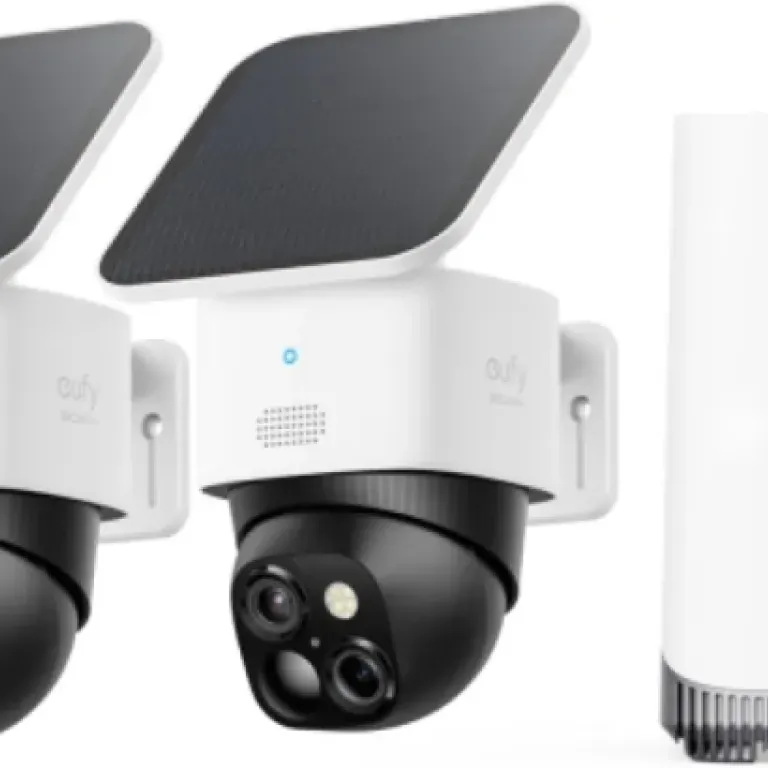
Summary
Analysis score
Average of the criteria rated below
Value: higher upfront cost to escape monthly fees
Compact PTZ domes with some mounting quirks
Solar power and battery: strong autonomy if placement is right
Outdoor readiness and long-term reliability signals
Video quality, AI detection, and app behavior in real-world feedback
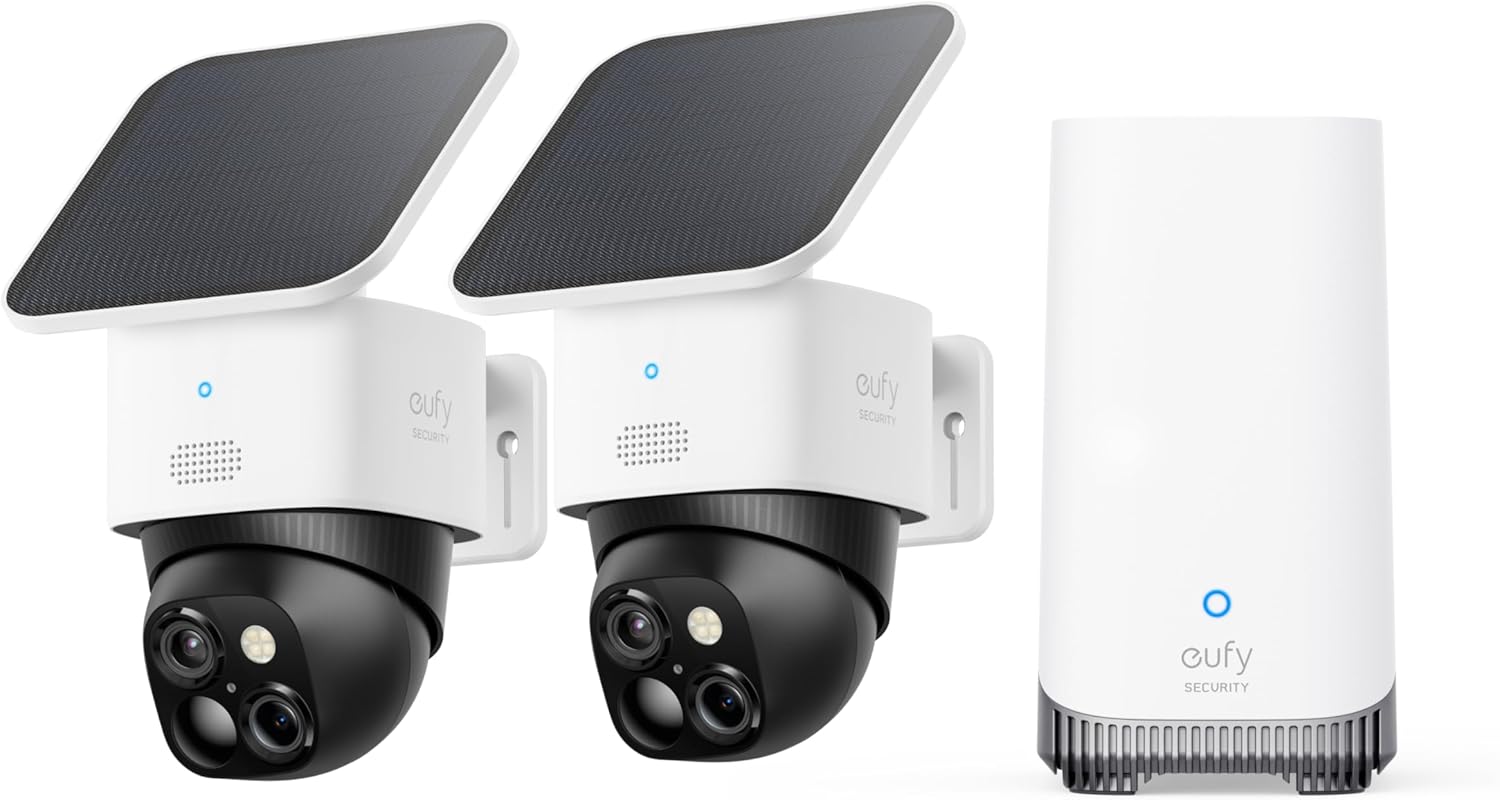
What the SoloCam S340 2-Cam Kit offers on paper
Pros
- High-resolution 3K video (up to 4K in some modes) with good feedback on clarity and zoom
- Solar-powered, battery-backed design that many buyers say runs almost maintenance-free with good placement
- Local storage on HomeBase S380 and AI detection (people, vehicles, general motion) without monthly subscription fees
Cons
- Wi‑Fi limited to 2.4 GHz, no 5 GHz support
- App account sharing and multi-user management can be confusing or unreliable according to some reviews
- Mounting hardware and solar panel arm could offer more flexibility for vertical installs and tricky sun angles

Specifications
View full product page →| Brand | eufy Security |
Solar cams that aim to replace subscriptions
The eufy SoloCam S340 2-Cam Kit with HomeBase S380 targets a very clear use case: people who want solid outdoor surveillance without paying a subscription every month. On paper, it checks a lot of practical boxes: solar power, 360° pan and tilt, local storage, and AI detection for people, vehicles, and general motion. The average 4.3/5 rating from well over four thousand reviews suggests that most buyers feel it delivers on those promises, even if a few rough edges remain.
What stands out immediately is the combination of dual cameras plus pan/tilt on a fully wireless, solar-powered body. Many brands force you into a cloud plan to unlock AI detection or longer clips; here, verified buyers repeatedly insist they get what they need from the free features. That’s a big deal if you’re tired of paying Ring/Blink-style fees just to keep basic recordings.
The flip side is that this isn’t some magic, flawless gadget. The spec sheet reveals some limitations, like 2.4 GHz Wi‑Fi only, and several comments bring up app quirks and motion detection that’s clearly better in daylight than at night. This is more of a high-feature, good-value camera than a luxury security system.
In my opinion, this kit is interesting for anyone who wants to cover several angles of a property with minimal wiring and minimal ongoing cost. It’s not perfect, and people picky about app polish or multi-user management might get annoyed, but in terms of feature/price ratio and freedom from subscriptions, it looks like a strong candidate.
Value: higher upfront cost to escape monthly fees
Several buyers directly address the price vs. value question. One calls the system a bit higher in cost than competing products but feels that “you do get what you pay for,” especially considering that no monthly fees are required for core features. Others emphasize that motion detection, AI classification (people, vehicles, animals), and up to 60-second clips are all available without a subscription, which is exactly where many rivals start charging.
When you add up what the kit gives you—two PTZ cameras, the HomeBase S380 for local storage, solar panels, and AI detection—the value looks solid for a multi-camera setup. A buyer who owns seven eufy cameras and covers both their main property and vacation home says they prefer this over Ring or Blink, largely because they can manage everything in one app and avoid ongoing storage or monitoring fees. That kind of usage scenario underlines the economic advantage: the more cameras you would otherwise be paying monthly for, the more a local-storage system pays off.
On the other hand, this is not the cheapest way to get basic video surveillance. If all you want is a single view of a front door and you don’t mind cloud subscriptions, you can probably find cheaper single-camera options. The SoloCam S340 2-Cam Kit is more suited to people who:
- Want wide coverage thanks to PTZ and dual cameras
- Strongly prefer local storage and no recurring fees
- Value higher resolution and AI detection over bare-bones recording
In my opinion, the value is good to very good for the right user profile: homeowners ready to pay more upfront to avoid subscriptions and to get better coverage from fewer cameras. If you’re extremely budget-sensitive and fine with paying a few dollars a month forever, cheaper cloud-locked systems might make more sense. But if you look at the total cost over a few years, the SoloCam S340 kit has a strong argument, especially with the solar panels cutting down on maintenance and the HomeBase eliminating cloud storage fees.
Compact PTZ domes with some mounting quirks
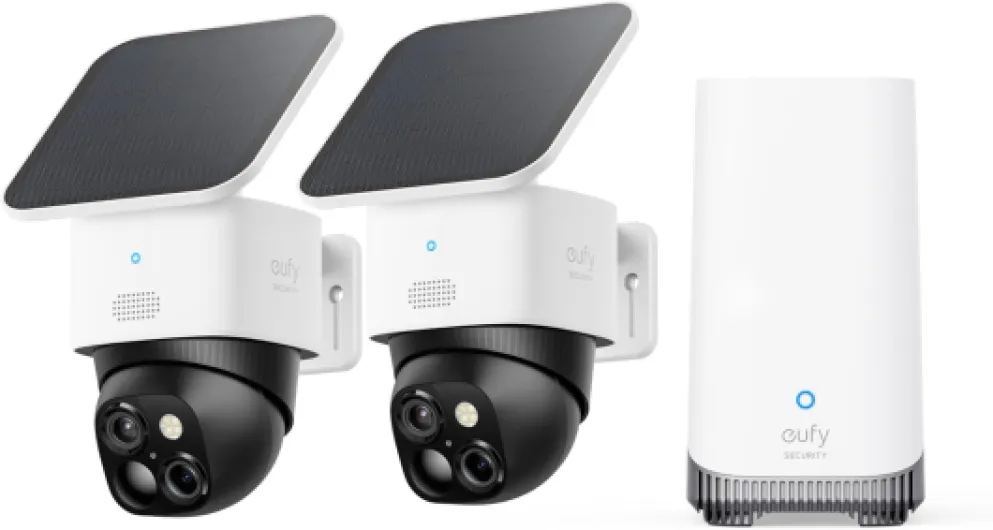
Visually and functionally, the SoloCam S340 is presented as a compact dome-style PTZ camera in a black-and-white finish. The spec sheet lists ceiling mount as the default mounting type, but several buyers discuss placing it on walls, eaves, and similar surfaces, so the included bracket seems reasonably flexible. The 360° pan and tilt is a central design element: one camera can cover a wide area instead of you having to install multiple fixed units pointing in different directions.
One buyer specifically mentions appreciating that the camera is not super bulky compared to others they considered. For outdoor gear, that matters: a smaller footprint is less visually intrusive on a home’s façade and easier to place under eaves or on a porch without looking like a commercial CCTV setup. The weight listed (7.33 pounds for the kit) suggests each unit is moderate in size rather than ultra-light, which is normal for a PTZ camera with motors and a battery.
However, the design is not flawless. A 4-star review points out two annoyances: they would have liked the mounting bracket to better support true vertical mounting (into a ceiling or rafter) and found the solar panel mount a bit too short for ideal positioning. That’s a classic trade-off: compact hardware sometimes means tighter constraints for panel angle and camera placement. If your eaves are deep or your sunlight angles are awkward, you may have to think harder about where to put both camera and panel.
The use of removable solar panels is a smart design choice: it gives you some separation between where the camera “sees” best and where the sun hits best. Even so, the short arm mentioned by one buyer hints that people with complex rooflines might need extension mounts or third-party brackets. In my opinion, the overall design looks practical and discreet for most standard homes, but it’s not the most flexible mounting solution on the market, especially if you want perfect vertical mounting or have tricky sun exposure.
Solar power and battery: strong autonomy if placement is right
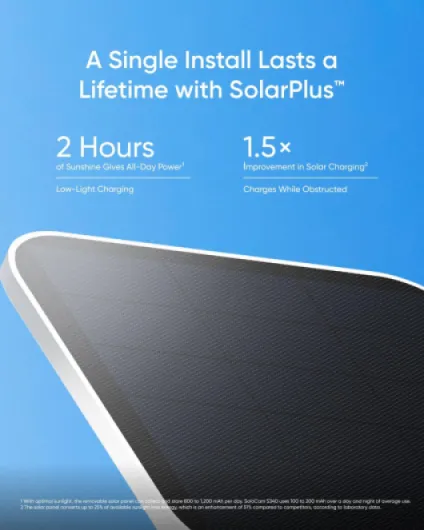
The SoloCam S340 stands out for its solar-powered, battery-backed design. The idea is simple: install once, let the small solar panel keep the internal battery topped up, and avoid climbing ladders every few weeks. Several buyers back this up with concrete feedback. One says their camera stays above 90% battery most of the time with the solar panel attached. Another, who owns multiple units, mentions that only the camera that gets poor sun needs a manual recharge about once every six months, while the others seem to run continuously.
On paper, the combination of a removable solar panel and wire-free design is very attractive. It means you can mount the camera where the view is best and the panel where the sun is best, within the limits of the short mount. This setup should be enough for typical residential use if you have at least a few hours of decent sunlight per day. In shaded or north-facing spots, you’ll likely still need to charge the battery occasionally, but that’s still far less maintenance than fully battery-only cameras.
Multiple reviews insist that placement is key for solar performance. If the panel is shaded by trees, rooflines, or only gets a brief window of direct light, you lose the “install and forget” benefit. One buyer explicitly praises the panel, saying it does its job very well, but that comment also implies they thought about where to put it. In my opinion, anyone considering this kit should map out sun exposure over a day before drilling holes.
There’s no detailed manufacturer claim about exact battery capacity or runtime in the spec chunk provided, but from the comments, it’s clear that the battery and solar combo is one of the strong points for most users. It won’t defy physics: heavy use of live view, spotlights, sirens, or frequent motion events will drain the battery faster. But if you’re in a reasonably sunny area and don’t hammer the live feed all day, the feedback suggests you can expect long intervals between any manual charging, or none at all once it’s set up well.
Outdoor readiness and long-term reliability signals
The SoloCam S340 is clearly intended for outdoor use, and the spec sheet explicitly labels it as such. While the exact IP rating isn’t listed in the provided data, the fact that it ranks highly among dome surveillance cameras and is marketed for yards, driveways, and porches implies weather resistance as a core design factor. Buyers comment on using it to cover entire properties and even vacation homes, which hints at year-round deployment in varied conditions.
One long-term owner mentions having multiple eufy cameras for about two years and still being satisfied, saying they have not regretted the purchase at all. While that’s an anecdote and not lab data, it’s still a good sign that the hardware and batteries aren’t falling apart after a short time. This same buyer notes that they only need to manually recharge the battery on a poorly placed unit roughly once in six months, which suggests the battery is holding capacity reasonably well over time.
From a construction perspective, the cameras combine motorized PTZ mechanisms, batteries, and solar panels, all of which can be stress points outdoors. Moving parts are more exposed to wear than fixed cameras, and extreme temperatures can affect batteries. There are no prominent complaints in the sampled reviews about the cameras failing mechanically, seizing up, or suffering obvious water ingress, which is reassuring. Usually, if a product had a widespread durability issue, it would dominate the comment section.
In my opinion, the durability picture is generally positive but not fully documented. You get signals of solid real-world longevity and no major pattern of defects, but also no precise information on impact resistance, exact weather rating, or how the PTZ motors behave in freezing climates. For most residential users in moderate climates, the available feedback suggests the S340 should hold up well. People in harsher environments (heavy snow, desert heat, salty coastal air) might want to dig deeper into additional reviews or consider positioning the cameras under some cover to give them a longer life.
Video quality, AI detection, and app behavior in real-world feedback
On performance, two things dominate the feedback: video quality and AI detection. Several 5-star reviews highlight that the image is clear, both in daytime and at night. One buyer says the video quality exceeded their expectations and calls out the black-and-white night vision in particular. Another mentions color at night as an option when there’s enough light, with IR taking over when it’s dark. With 3K resolution and up to 4K under some modes, the hardware should have enough pixels to support meaningful zoom, and buyers confirm that zooming in to identify people or vehicles stays usable.
AI features also get a lot of positive comments. Buyers like being able to choose what the camera reacts to: people, cars, any movement. One review describes the AI tracking as “awesome” and says the camera follows people and vehicles through a cul-de-sac. That matches the PTZ design: instead of just detecting motion in a fixed frame, the camera can physically track the subject, which is a big plus for wide driveways or yards where a static camera might miss critical angles.
There are limits, though. One verified buyer notes that motion detection is strongest in daylight and within about 30–40 feet. They say night vision is very clear, but motion detection range seems reduced in the dark. That’s not surprising: many consumer cameras rely on contrast or IR reflection, which is harder to interpret at distance at night. If you need very long-range detection in low light, this kind of battery/solar PTZ is not going to match a wired, high-power professional setup.
The app experience gets mixed but generally positive feedback. Multiple people praise the software as one of the best they’ve used, especially considering it’s free and doesn’t require a subscription. Features like live view, PTZ controls, person/vehicle filters, and alerts appear to be well implemented. However, there are complaints about account sharing: one detailed review explains that inviting another resident via email didn’t work as expected, and when the second person tried to add the HomeBase to their own account, it disappeared from the original account. They ended up all using a single login, with occasional logouts on phones. In my opinion, that’s a classic sign of decent core functionality but weaker multi-user design. If you plan to share access with family, expect a bit of friction.
What the SoloCam S340 2-Cam Kit offers on paper
The SoloCam S340 2-Cam Kit bundles two SoloCam S340 units with a HomeBase S380 hub. Each camera is a wireless, solar and battery-powered outdoor unit with PTZ (pan-tilt-zoom) capability, 3K video capture, and AI object detection. The cameras connect over 2.4 GHz Wi‑Fi and are designed mainly for outdoor security: monitoring porches, driveways, yards, or similar areas. The HomeBase handles local storage, so recordings stay on-site instead of going to the cloud.
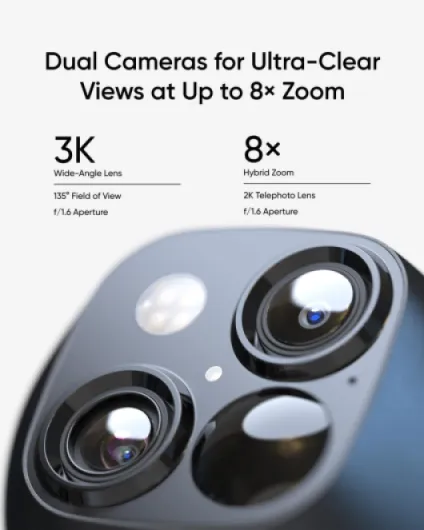
On resolution, eufy advertises 3K clarity in normal use and up to 4K when AI tracking or dual views are enabled. Buyers frequently mention sharp video and a clear zoom, with one review highlighting that they can zoom in 3× and still see details that cheaper cameras would blur. Another verified buyer says the black-and-white night vision quality exceeded their expectations, which suggests that the hardware and processing are at least solid for this price range.
The key functional promise is no monthly fee. Local storage on the HomeBase and on-device/edge processing allow AI detection (people, vehicles, general motion) and up to 60-second clips without any subscription, according to multiple reviews. Several buyers explicitly compare this to Ring and Blink, saying they switched or expanded with eufy precisely to avoid recurring costs while still keeping smart detection and notifications.
In daily use terms, the product is positioned as a relatively quick install: eufy markets a 7-minute installation per camera thanks to the compact, wire-free design and the removable solar panel. On paper, this kit makes sense for a homeowner who wants to cover multiple sides of a house with a single ecosystem, using the HomeBase as the central point for storage and control. If you’re expecting enterprise-grade features or PoE reliability, this isn’t that; but for typical residential use, the feature list is quite complete.
Pros
- High-resolution 3K video (up to 4K in some modes) with good feedback on clarity and zoom
- Solar-powered, battery-backed design that many buyers say runs almost maintenance-free with good placement
- Local storage on HomeBase S380 and AI detection (people, vehicles, general motion) without monthly subscription fees
Cons
- Wi‑Fi limited to 2.4 GHz, no 5 GHz support
- App account sharing and multi-user management can be confusing or unreliable according to some reviews
- Mounting hardware and solar panel arm could offer more flexibility for vertical installs and tricky sun angles
Conclusion
Analysis score
The eufy SoloCam S340 2-Cam Kit with HomeBase S380 positions itself as a subscription-free, solar-powered surveillance setup for people who want broad coverage without running cables. On paper and in the reviews, the strongest points are clear: sharp 3K–4K video, effective AI detection and tracking, real 360° pan/tilt coverage, and solar-backed batteries that many buyers say rarely need manual charging if the panels are well placed. For a lot of homeowners, that combination is exactly what they’re looking for.
It’s not flawless. Limiting Wi‑Fi to 2.4 GHz only will annoy some users, motion detection appears notably stronger in daylight than at night, and the app’s account-sharing system can be clumsy according to one detailed review. Mounting flexibility could also be better, especially if you want perfect vertical mounting or need more reach for the solar panels. None of these are deal-breakers for most people, but they are worth knowing before you commit.
In my opinion, this kit suits users who want to cover several sides of a property, dislike paying monthly fees, and are ready to spend a bit more upfront for a more capable, local-storage system. If you’re obsessed with ultra-polished multi-user apps or you live in a spot with very poor sun exposure, you might want to look at alternatives or plan your installation carefully. Overall, it’s a strong value package for subscription-averse buyers who want flexible, high-resolution outdoor monitoring with minimal ongoing fuss.